
Yarn library — every yarn book includes the supplier mill, fibre origin and certification status.
Almost every quote request we get from a new brand client now includes some version of: "Are your fibres OEKO-TEX certified?" or "Can you do RWS merino?". Sustainability certifications have moved from a niche concern to a baseline expectation in mid-market and premium knitwear. But the certification landscape is genuinely confusing — there are at least a dozen overlapping schemes, each with its own scope, audit process, and cost. This guide explains what each major certification actually covers, when your brand needs it, and what we can deliver as your manufacturer.
Why certifications matter for knitwear brands in 2026
Three forces have made textile certifications mainstream:
Retailer requirements. Major European retailers — Zalando, Asos, El Corte Inglés, About You — now require minimum certification standards for any knitwear listed on their platforms. The EU's Strategy for Sustainable Textiles, adopted in 2023, has tightened these requirements year on year. By 2026 most mid-market EU retailers will not even accept a quote without OEKO-TEX or equivalent.
Customer trust. A growing share of US and UK direct-to-consumer customers actively filter for certifications when comparing knitwear brands. A 2024 study by Cotton Inc. found that 58% of US consumers under 40 said they "would pay more for a sweater with a recognised sustainability label". Even a $40 Amazon listing benefits from an OEKO-TEX badge in the product photo.
Marketplace policy. Amazon's Climate Pledge Friendly programme, Etsy's eco-friendly badge, and Faire's sustainability filter all surface certified products higher in default search. For sellers, certification is no longer just compliance — it is a discoverability lever.
OEKO-TEX STANDARD 100 — the universal baseline
OEKO-TEX STANDARD 100 is the single most widely-recognised textile certification globally. It tests finished products (yarn, fabric, or finished garment) for harmful substances — formaldehyde, heavy metals, restricted azo dyes, allergenic disperse dyes, and over 350 other regulated chemicals. It is what European retailers refer to when they ask for "tested for harmful substances".
| What it covers | What it does NOT cover |
|---|---|
| Chemical residues in finished textile | How fibre was farmed or animal welfare |
| Skin contact safety | Carbon footprint or water usage |
| Heavy metal limits | Worker conditions in factory |
| pH levels | Recyclability or biodegradability |
Cost and timeline: a single OEKO-TEX STANDARD 100 test report from an authorised lab (Hohenstein, TESTEX, etc.) costs around USD 350–800 per fabric variant and takes 2–3 weeks. Once certified, the report is valid for 12 months and covers all garments made from that fabric.
GRS (Global Recycled Standard) — for recycled fibres
If your sweater contains recycled wool, recycled cotton, recycled polyester, or any other recycled fibre, GRS is the certification that proves the recycled content claim is real. It is administered by Textile Exchange and audited by certified bodies like Control Union.
GRS certifies the entire chain: from the recycling facility, through yarn spinning, knitting, finishing, and packing. For a brand to put a "GRS-certified" hangtag on a sweater, every supplier in the chain must hold a valid GRS scope certificate. This is more demanding than OEKO-TEX, which only tests finished products.
Two thresholds matter:
- 20% minimum recycled content — to use the GRS logo on the product
- 50% minimum recycled content — to make a "made with recycled materials" front-of-pack claim under most EU regulations
For knitwear, recycled wool is the most commercially viable. We work with two yarn suppliers offering GRS-certified recycled wool blends (typically 50% recycled wool / 50% virgin merino) at a premium of about 15–25% over standard yarn cost. Recycled cotton is also available but tends to have shorter fibres and lower durability — we usually recommend it only for chunky-gauge styles where pilling is less of an issue.
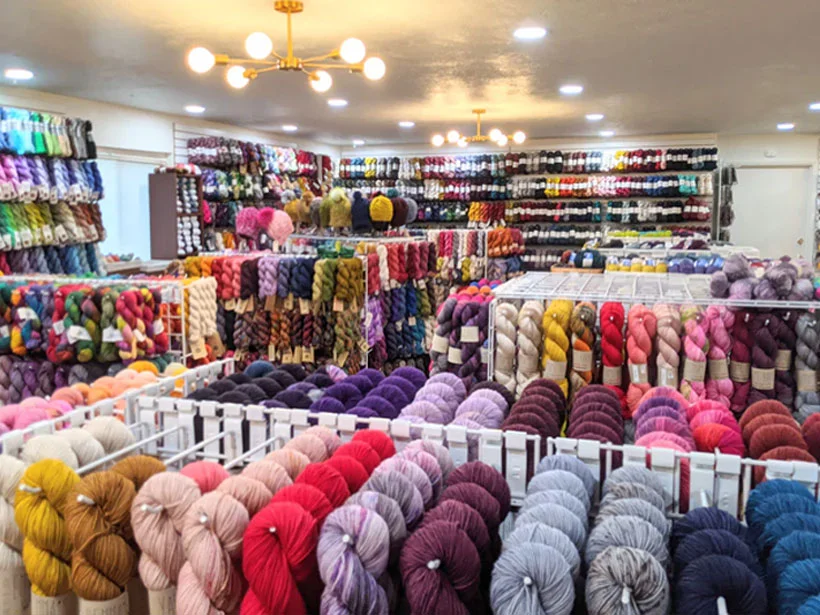
Yarn store — GRS-certified recycled wool blends are tagged with the supplier scope number.
RWS (Responsible Wool Standard) — specifically for merino
RWS is a wool-specific standard that covers animal welfare and land management at the farm level. It is the answer to consumer concerns about mulesing, a controversial practice in some Australian merino farms. RWS-certified merino comes from farms that have committed to non-mulesing practices and rotational grazing.
RWS is most relevant if your brand:
- Sells into Germany, Scandinavia, the Netherlands, or the UK (where animal welfare scrutiny is highest)
- Targets the outdoor / lifestyle segment (Patagonia, Icebreaker, Smartwool style positioning)
- Uses 100% merino or merino-dominant blends
For acrylic, cotton, or cashmere brands, RWS is irrelevant — wool isn't your primary fibre. For cashmere specifically, the equivalent is the SFA (Sustainable Fibre Alliance) standard, which addresses Mongolian goat herding practices.
RWS-certified merino runs about 20–35% more expensive than standard merino at the yarn level. The price premium narrows on finished garments because labour cost dominates. If you're building a premium merino programme, the cost is worth it. If you're competing on price in a basic merino sweater category, it usually isn't.
For cotton brands: GOTS, BCI, OCS — what's the difference?
Cotton has the most fragmented certification landscape because cotton is one of the most environmentally controversial commodity fibres globally. The three you'll encounter:
| Standard | What it certifies | Premium | Best for |
|---|---|---|---|
| GOTS (Global Organic Textile Standard) | Organic cotton, full chain (farm to garment), prohibited chemicals | 30–50% | Premium organic-positioned brands, EU markets |
| OCS (Organic Content Standard) | Organic cotton content tracking only — does not regulate processing chemicals | 15–25% | Brands wanting organic claim without GOTS overhead |
| BCI (Better Cotton Initiative) | Mass-balance system — improved farming practices, but cotton is mixed in supply chain | 5–10% | High-volume mainstream brands seeking entry-level claim |
For knitwear specifically, we generally recommend GOTS for premium positioning and OCS for brands that want organic cotton without paying for the full GOTS audit. BCI is technically the cheapest but is increasingly criticised for being too weak — many EU retailers no longer accept BCI as standalone proof of sustainability.
For a deeper material comparison covering when cotton, merino, or cashmere makes more sense for your brand, see our material strategy guide.
Other certifications worth knowing
BLUESIGN — focuses on chemical management throughout the supply chain. More rigorous than OEKO-TEX on process inputs (dyes, finishes), but less focused on finished-product testing. Common in outdoor and performance brands.
Fair Trade Certified — addresses worker pay and conditions. Mostly relevant for vertically-integrated brands with strong social-impact stories. Less applicable for typical OEM knitwear sourcing.
Cradle to Cradle Certified — covers material reusability, renewable energy, water stewardship, social fairness, and recyclability. Comprehensive but expensive — usually only economical for large premium programmes.
EU Ecolabel (the "EU flower") — government-backed European label for low environmental impact. Underused by Chinese factories because of the audit complexity, but increasingly recognised by EU retailers.
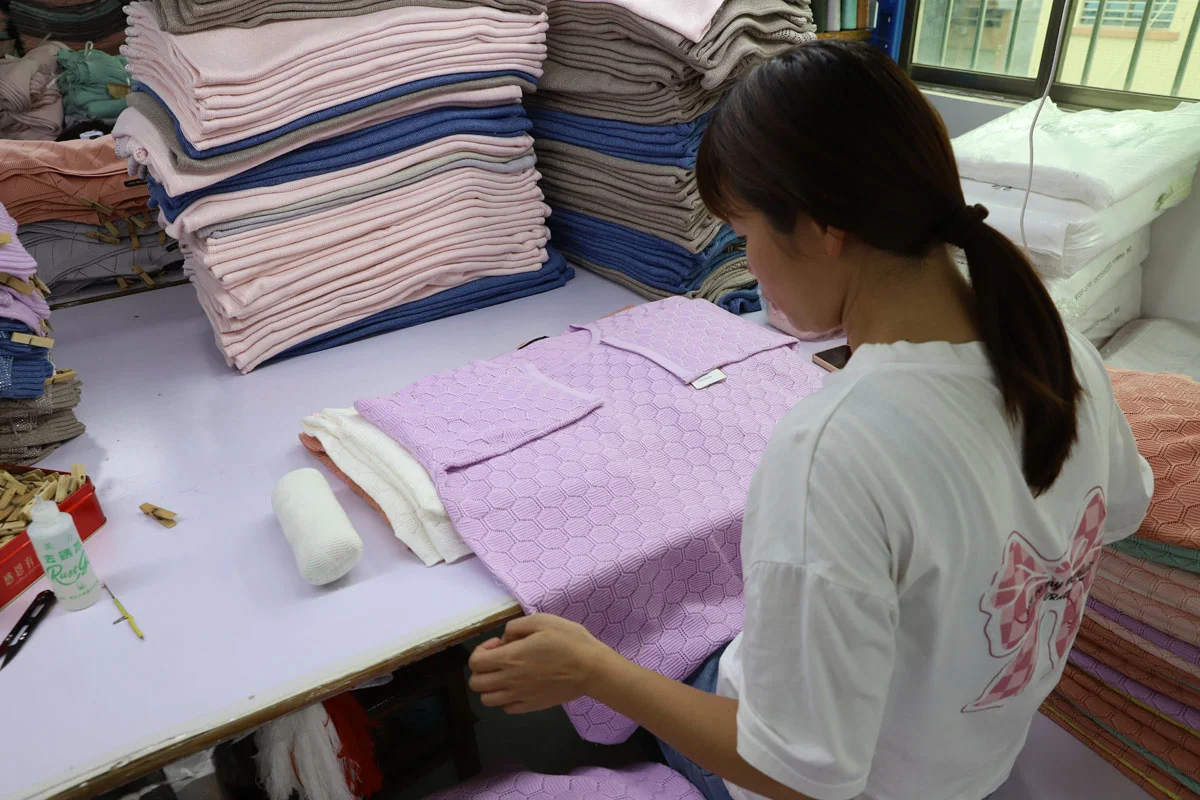
QC station — every order ships with the certification documentation matched to the production lot.
How we can help with certifications
Let us be straight with you: Lin Sweater Factory itself does not currently hold OEKO-TEX, RWS, GRS, or GOTS scope certification as a converter. What we can do is coordinate with our partner certified yarn mills when your order size justifies it:
- OEKO-TEX STANDARD 100 test on the yarn — our cashmere, merino, and cotton yarn suppliers can arrange testing on the yarn batch used for your order (~2–3 weeks lead time). Note: this certifies the yarn, not the finished garment chain.
- RWS-certified merino yarn via a partner mill in Inner Mongolia and an Australian-origin merino spinner. Scope and transaction certificates are practical for orders above ~200 pieces; smaller volumes are case-by-case as the mill may not run a small certified batch.
- GRS-certified recycled wool blends through two qualified yarn partners. Whether transaction certificates can be issued depends on order size — please share your target volume up front.
- GOTS-certified organic cotton via a partner mill. MOQ is significantly higher (typically 500+ pieces) because organic cotton must be physically segregated from conventional cotton on our knitting lines.
- Third-party fibre composition test reports from SGS, Bureau Veritas, or Intertek — we can arrange these independently with no minimum order, useful when you need an independent verification of fibre content.
If your retailer requires a certificate that traces all the way to the finished garment (not just the yarn), every step — including our knitting and finishing — needs scope certification, which we currently do not carry. In that case we will say so up front: we can either point you to a fully scope-certified partner factory, or discuss a longer-term scope-certification process for an ongoing programme. See our export documents guide for the full paperwork list by destination market.
Five common mistakes brands make with certifications
1. Asking for "all the certifications" upfront. Brands send us briefs requesting OEKO-TEX, RWS, GRS, GOTS, and BLUESIGN simultaneously. Each adds cost. Decide which two or three are essential for your retail channel and skip the rest. Marketing departments often want the longest possible list — the right answer is usually the shortest list your retailer will accept.
2. Confusing fibre certification with garment certification. RWS-certified merino yarn is not the same as an RWS-certified sweater. To make the latter claim on a hangtag, every step of the chain needs scope coverage, not just the yarn. This is where many small brands accidentally make claims they can't actually substantiate.
3. Paying for certifications the retailer doesn't actually require. Always ask the retailer's compliance team for the exact certification list before placing your order. We've seen brands pay 25% extra for GRS only to discover the retailer would have accepted standard yarn with an OEKO-TEX report.
4. Forgetting that certifications expire. OEKO-TEX is valid for 12 months. RWS scope certificates are typically annual. If you place a repeat order 14 months after the original, you may need to re-test. Plan for this in your re-order calendar.
5. Trusting vague claims like "eco-friendly" or "natural". These have no regulatory definition and increasingly trigger greenwashing scrutiny in the EU under the Green Claims Directive. Stick to specific certifications you can document. "Made with OEKO-TEX-certified cotton" is defensible. "Sustainably made" is not.
How to choose: a simple decision framework
Based on hundreds of brand briefs we've handled, the most practical approach is to start with your primary fibre + your primary market, then add specific certifications only as the retailer requires:
| Your fibre | Your market | Recommended certification stack |
|---|---|---|
| Merino wool | Germany, Scandinavia, UK | OEKO-TEX + RWS |
| Merino wool | US Amazon / general retail | OEKO-TEX (RWS optional) |
| Cashmere | Premium US/EU | OEKO-TEX + SFA (cashmere) |
| Cotton (premium) | EU organic positioning | OEKO-TEX + GOTS |
| Cotton (mainstream) | Mass market | OEKO-TEX + BCI or OCS |
| Recycled wool blend | Eco-positioned brands | OEKO-TEX + GRS |
| Acrylic / blends | Value or fashion segment | OEKO-TEX (sufficient) |
OEKO-TEX is the constant in every recommended stack — it is the cheapest, fastest, and most universally recognised baseline. Everything else is layered on top depending on fibre and market.
Source certified knitwear with documented compliance
Send us your fibre preference and target market — we'll come back within 24 hours with a quote that includes the right certification stack, lead times, and the documentation package you'll need at customs and on your hangtag.