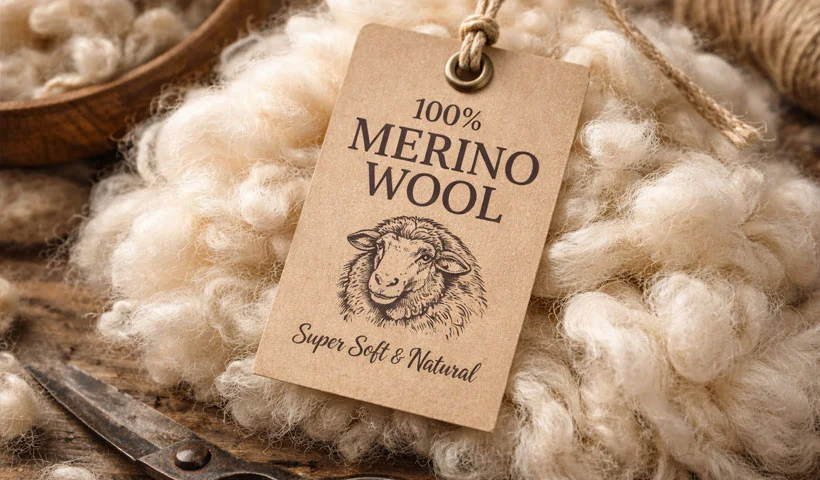
One of the most common questions buyers ask us is: "Should I use merino or regular wool?" The honest answer is: it depends entirely on your customer, your price point, and your brand positioning. This guide breaks down the real differences — from a factory that works with both every day.
What is merino wool?
Merino wool comes from Merino sheep, primarily raised in Australia and New Zealand. Its key characteristic is fibre diameter — typically 17–24 microns, compared to 25–40 microns for standard wool. This matters because finer fibres are softer against skin. Wool under about 22 microns generally does not itch — a common complaint with cheaper wools.
Merino also has natural temperature-regulating properties, moisture-wicking ability, and odour resistance that regular wool lacks. These are real functional benefits, not just marketing language.
The numbers: cost comparison
| Yarn type | Approx. yarn cost/kg | Per sweater (300g) | Best for |
|---|---|---|---|
| Acrylic | ¥40–60 | ¥12–18 | Entry-level, basics |
| Regular wool blend (30%+) | ¥80–130 | ¥24–39 | Mid-market |
| Merino wool | ¥120–180 | ¥36–54 | Premium, lifestyle brands |
| Cashmere blend | ¥300–600+ | ¥90–180+ | Luxury, gifting |
For context, yarn typically accounts for 35–45% of total sweater cost. Upgrading from a wool blend to merino adds roughly ¥15–20 to your yarn cost per piece — which translates to approximately ¥35–50 in additional manufacturing cost when all factors are included. See our full production cost guide for more detail.
Feel and wearability
| Property | Merino wool | Regular wool blend | Acrylic |
|---|---|---|---|
| Next-to-skin softness | ★★★★★ | ★★★☆☆ | ★★☆☆☆ |
| Warmth | ★★★★★ | ★★★★☆ | ★★★★☆ |
| Breathability | ★★★★★ | ★★★☆☆ | ★★☆☆☆ |
| Odour resistance | ★★★★★ | ★★★☆☆ | ★★☆☆☆ |
| Pilling resistance | ★★★☆☆ | ★★★★☆ | ★★★★★ |
| Durability | ★★★★☆ | ★★★★☆ | ★★★★★ |
When to choose merino
Merino makes sense when:
- Your retail price is above USD 80–100 (customers at this price point expect premium feel)
- You're targeting a lifestyle or outdoor brand audience who values function
- You're selling direct-to-consumer and "merino wool" is a genuine selling point
- The product will be worn next to skin (base layers, fine-knit cardigans)
When regular wool (or a blend) is the better choice
A well-chosen wool blend often delivers 80% of merino's feel at 50–60% of the cost. This is the right call when:
- Your target retail price is under USD 60–70
- The sweater is worn over a shirt or t-shirt (outer layer, not next to skin)
- You need higher pilling resistance for a workwear or casualwear product
- You're doing a large volume order where cost control matters more than premium positioning
Understanding gauge and yarn weight also affects which wool type is appropriate — finer gauges (12G, 14G) pair better with merino, while chunky gauges (3G, 5G) are often just as good in a regular wool blend.
What about superwash merino?
Superwash merino has been treated to prevent shrinkage and allow machine washing. This is a significant practical benefit for retail products — customers who can't machine wash a sweater often return it. The treatment adds about 15–20% to yarn cost but can reduce customer complaints substantially. For products sold through e-commerce, we often recommend superwash merino specifically because of the lower return rate.
Certifications to look for
If sustainability matters to your brand, ask your factory about:
- RWS (Responsible Wool Standard) — certifies ethical sheep farming practices
- OEKO-TEX STANDARD 100 — certifies no harmful substances in the finished product
- ZQ Merino — premium certification for New Zealand merino
At Lin Sweater, we can source RWS-certified merino and provide OEKO-TEX documentation for export to markets that require it. For buyers selling into the EU or US, these certifications are increasingly expected. See our export documentation guide for more on compliance requirements.
Need help choosing the right yarn?
Tell us your product and target price. We'll recommend the best yarn option and send physical swatches to your door.