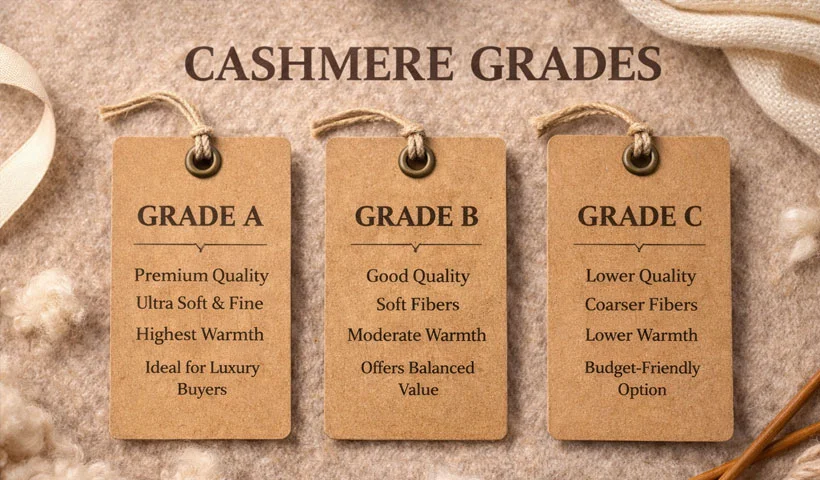
Cashmere is one of the most misunderstood fibres in the fashion industry. "100% cashmere" on a label tells you very little — a ¥300 sweater and a ¥3,000 sweater can both carry that label. What matters is the grade. This guide explains the grading system from a factory that sources and works with cashmere every season.
How cashmere is graded
The three key measurements are: fibre diameter (microns), fibre length (mm), and whiteness. All three affect the final product feel and price.
| Grade | Diameter | Length | Best for | Price vs Grade B |
|---|---|---|---|---|
| A (top grade) | ≤15.5μm | ≥36mm | Luxury brands, gifting | +80–120% |
| B (mid grade) | 15.5–17μm | 34–36mm | Premium retail | Baseline |
| C (standard) | 17–19μm | 30–34mm | Mid-market | −20–30% |
Where cashmere comes from
Inner Mongolia (China) produces the world's finest cashmere — Grade A fibres as fine as 14–15 microns. Outer Mongolia and Iran produce good quality cashmere (Grade B) at lower prices. Afghan cashmere is lower grade but widely used in budget products.
When a factory says "Inner Mongolian cashmere", ask for the fibre diameter specification. "Inner Mongolian" is a marketing term as much as a technical one.
Cashmere blends: a practical middle ground
Pure cashmere is expensive and, at lower grades, can pill significantly. Many premium brands use cashmere blends — typically 70–30 or 50–50 with merino wool. This delivers most of the softness benefit at a lower cost and with better durability. A 70% Grade A cashmere / 30% merino blend is often a better product than 100% Grade C cashmere at a similar price point. See our cashmere sweater manufacturing page for what our factory can produce.
How to verify what you're getting
Ask your factory for: the cashmere supplier's fibre test report, the yarn supplier's certificate showing diameter specification, and an independent fibre content test report from a third-party lab (SGS, Bureau Veritas). Don't rely on factory assurances alone — legitimate suppliers welcome verification. See our export documentation guide for more on compliance testing.
What to charge for cashmere products
Grade A cashmere sweaters at retail realistically need to be priced above USD 200 to reflect material cost. Grade B/C cashmere or cashmere blends can retail from USD 80–150 with healthy margins. If you see "100% cashmere" sweaters at USD 40–50 online, they are either mislabelled or using the lowest-grade short-fibre cashmere that pills immediately. For a breakdown of what drives knitwear manufacturing costs, see our cost guide and our guide on comparing factory quotes.
Ready to start your knitwear project?
Lin Sweater Factory — Dalang, Dongguan. MOQ from 300 pcs. Reply within 24 hours.