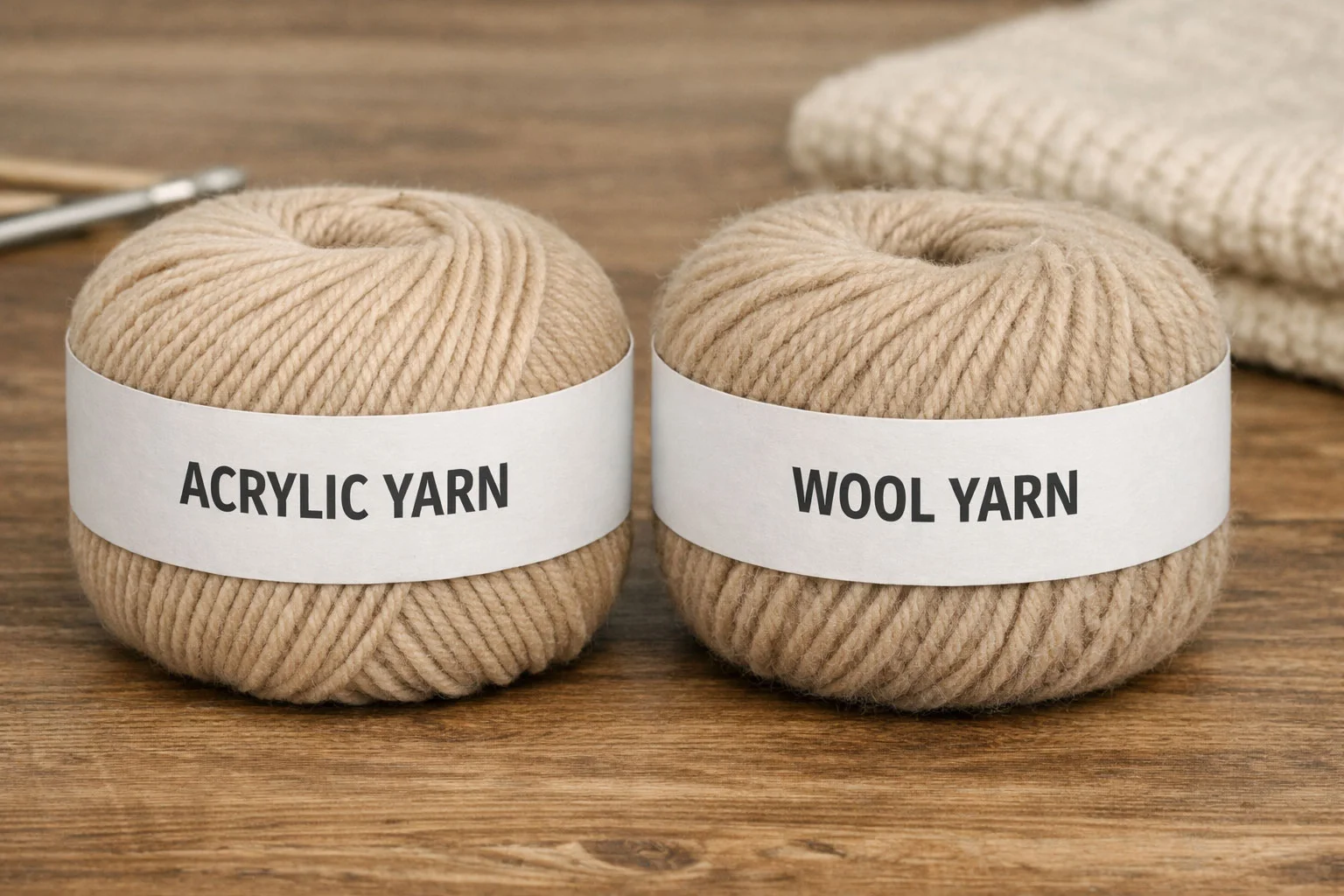
Most guides on acrylic vs wool are written for consumers deciding what to buy. This one is written for brand buyers deciding what to manufacture. The questions are different. The answers are different. And the consequences of getting it wrong show up in your margins, your return rates, and your customers' trust — not just in how warm a garment feels.
At Lin Sweater Factory in Dalang, Dongguan, we work with both yarn families every day. This is our honest account of how each one behaves in production, what it costs, where it performs well commercially, and the situations where one is clearly the wrong choice — even if the buyer is pushing for it on price.
Acrylic — what it actually is and what it does well
Acrylic is a synthetic fibre made from polyacrylonitrile — a petroleum-derived polymer. In knitwear manufacturing, it is the dominant fibre for budget and mid-range production globally, and for good reasons that go beyond price.
What acrylic does well in production
Acrylic's performance characteristics are more nuanced than "it's cheap." Three properties make it genuinely valuable in knitwear production:
- Colour consistency. Acrylic takes dye extremely evenly and holds colour reliably across production lots. For brands running multiple colourways with tight colour standards — seasonal brights, pastels, fashion neutrals — acrylic delivers more consistent batch-to-batch colour than most natural fibres. Pale purple and sage green, for example, are significantly harder to hold consistent in cotton or wool than in acrylic.
- Dimensional stability. Acrylic does not shrink, felt, or distort with washing the way wool can. For brands whose customers machine wash without reading care labels — which is most mass-market customers — acrylic garments survive washing misuse that would destroy a wool piece.
- Bulk and loft. Modern bulked acrylic yarns can produce a garment that looks and feels substantially warmer and fuller than a wool piece at the same weight and price. The visual warmth signal — chunky, lofty, cosy — is achievable at a price point where wool simply cannot compete.
- Retail price is under £30–40
- Machine washability is non-negotiable
- Producing Christmas or seasonal sweaters
- High-volume basics requiring colour consistency
- Kids' knitwear — durability over softness
- Jacquard with many colours — cost control
- Fast fashion or trend-led collections
- Retail price is above £60–80
- Brand positioning is premium or sustainable
- Fine gauge (10G+) — acrylic pills faster
- Customer base values natural fibre credentials
- Selling into premium department stores
- Labelling requires "natural fibre" claims
Wool — when the premium is justified
Wool is a protein fibre grown from sheep. Its performance characteristics are genuinely different from acrylic — not just in feel, but in how the fabric functions on the body. Understanding what those differences mean commercially is what allows a buyer to make the right decision rather than an emotional one.
What wool does that acrylic cannot replicate
Wool's commercial justification is not primarily about feel — it is about the properties that translate into lower return rates and higher customer satisfaction scores at premium price points:
- Temperature regulation. Wool fibres absorb and release moisture, moderating body temperature in both directions. A wool sweater is comfortable in a wider temperature range than an acrylic one. For brands selling into markets with variable indoor climates — the UK, Northern Europe, Japan — this has real commercial value.
- Natural odour resistance. Wool absorbs and neutralises perspiration odour better than any synthetic. A wool sweater can be worn more times between washes without developing odour — relevant for premium brands whose customers expect garments to "perform."
- Biodegradability. For brands with sustainability credentials, wool is biodegradable and renewable. Acrylic is not. For buyers whose retail partners require sustainability documentation, this distinction matters operationally, not just aesthetically.
- Premium visual signal. A wool content declaration on the care label signals quality to the consumer. At the same retail price point, "100% wool" reads as more valuable than "100% acrylic" in every premium market we supply to.
- Retail price supports a £300+ price point
- Selling into premium or independent retail
- Brand positioning requires natural fibre
- Autumn/winter collection — warmth is primary
- Buyers value sustainability credentials
- Repeat purchase depends on quality perception
- Retail price is below £30–35
- Machine washability is required
- Producing children's knitwear at scale
- Running a fast-fashion seasonal programme
- Complex jacquard with 4+ colours (cost)
The middle ground — blends
Most commercially successful mid-market knitwear sits in the blend category — not pure acrylic, not pure wool, but a calculated mix that delivers a better commercial outcome than either extreme. Understanding how blends work gives buyers more options when specifying.
Enough wool content to justify "wool blend" labelling and feel improvement. Cost increase over pure acrylic: 40–60%. Best for mid-market brands at £35–60 retail.
Meaningful warmth and handle improvement. Machine washable in many formulations. Good all-round choice for brands that need a tangible quality step without full wool pricing.
Softest next-to-skin performance. Strongest retail premium justification. For brands at £80–150+. See our full merino vs regular wool guide.
Nylon adds abrasion resistance to wool — excellent for outerwear-adjacent knitwear and styles that need to last 3–5 seasons. Common in Scandinavian and workwear-influenced brands.
Breathable, machine washable, colour-stable. The dominant spring/summer knitwear yarn category. Good colour saturation for fashion pastels. See our spring 2026 trend guide.
Cashmere content adds softness and retail story at lower cost than pure cashmere. Effective for mid-premium positioning. See our cashmere grades guide.
Full comparison for brand buyers
| Factor | Pure Acrylic | Wool Blend (30/70) | 100% Wool / Merino |
|---|---|---|---|
| Yarn cost (Dalang) | ¥15–30/kg — lowest | ¥40–70/kg | ¥80–180/kg |
| Ex-factory price impact | Base price | +25–45% | +60–150% |
| Machine washable | Yes — always | Often yes | Usually no |
| Colour consistency | Excellent | Good | Requires dye-lot approval |
| Pilling tendency | Moderate — grades vary | Low–moderate | Low (merino especially) |
| Breathability | Low | Medium | High |
| Retail price positioning | Under £40 | £35–80 | £60–200+ |
| Sustainability claim | None — petroleum-derived | Partial | Natural, biodegradable, renewable |
| Best season | All — especially A/W | All seasons | Autumn / Winter |
| MOQ at Lin Sweater | 300 pcs | 300 pcs | 300 pcs |
How the choice affects production
The yarn choice affects more than cost — it changes how the garment is handled at every production stage. Buyers who are aware of these differences can brief their factory more precisely and reduce sampling surprises:
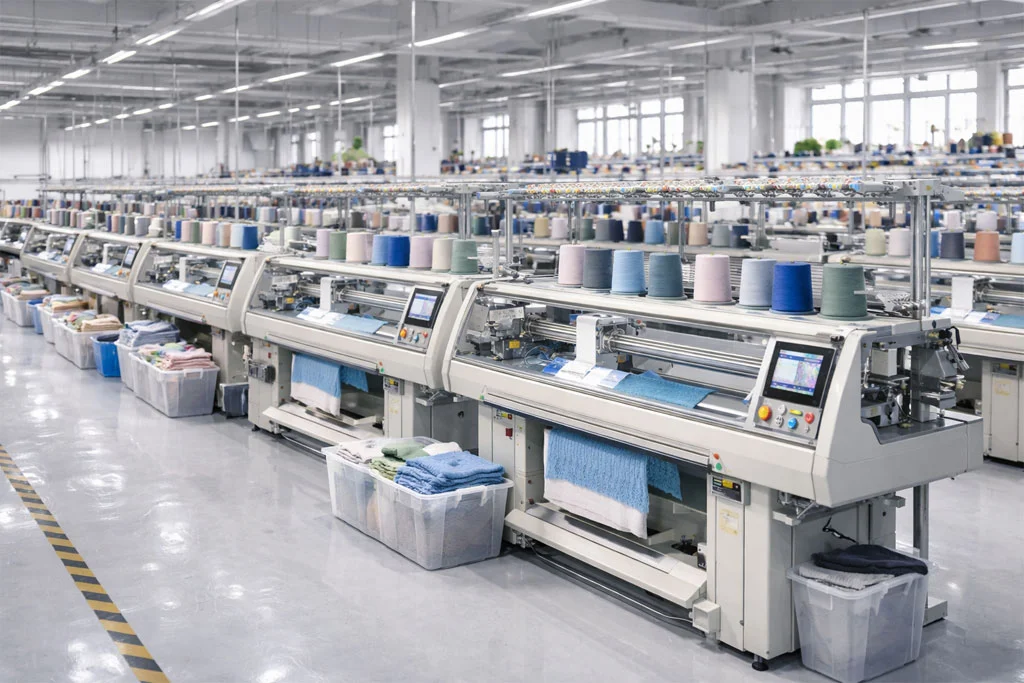
- Tension settings. Wool is more elastic than acrylic. The machine tension must be calibrated differently for each fibre to produce the correct stitch dimension and fabric hand. A factory that primarily produces acrylic will need to recalibrate for wool — experienced factories do this routinely; inexperienced ones may not.
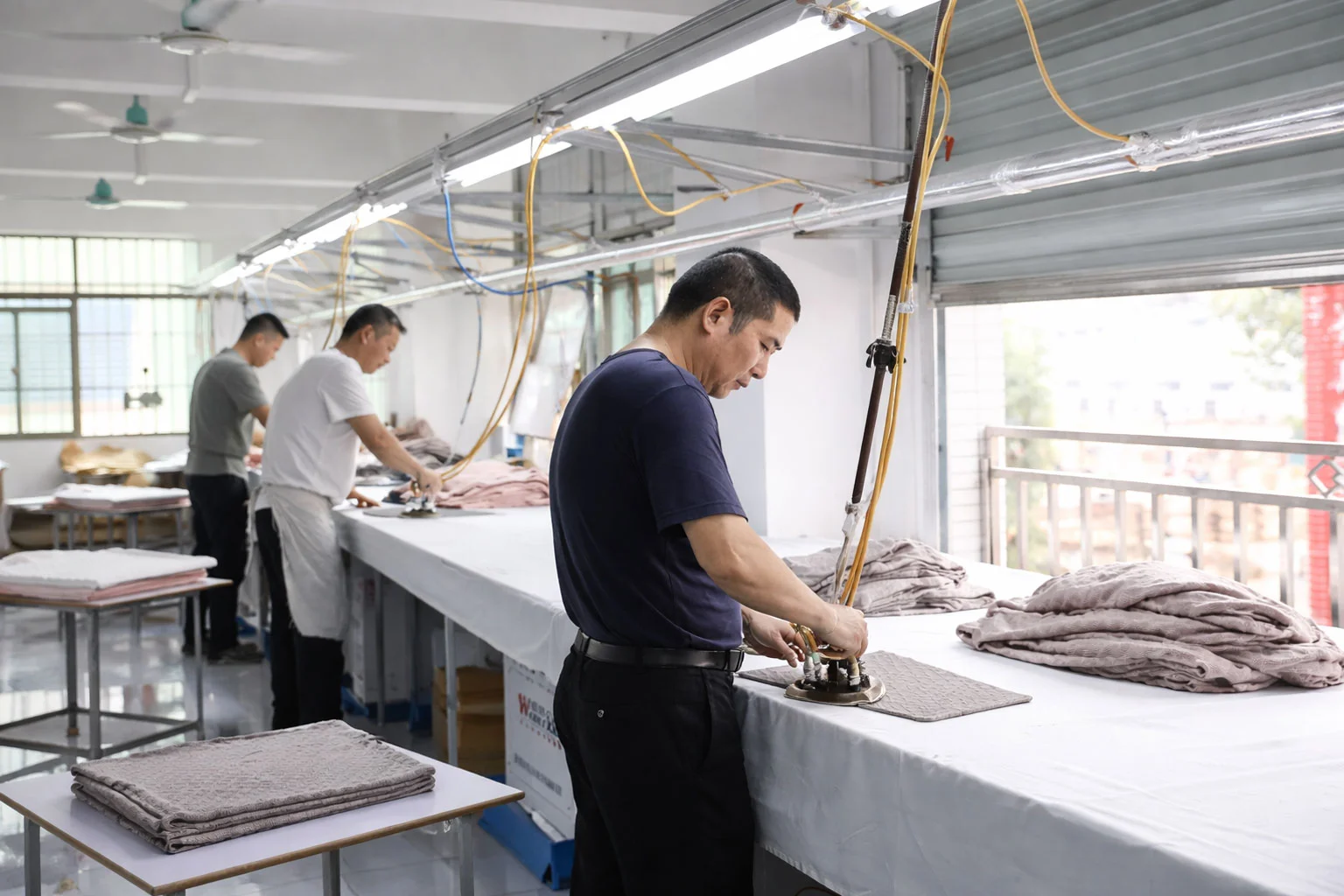
- Finishing temperature. Wool requires careful steam temperature control during pressing. Too hot and the fibres felt and lose their structure permanently. Acrylic is more forgiving at the finishing stage but can melt if temperature control is poor — a different risk profile, not a safer one.
- Dye lot management. Wool dye lots vary more than acrylic. For a 200-piece production run in a mid-tone colour, we may receive two or three dye lots from the yarn supplier — all within tolerance, but with visible variation if placed side by side. We manage this by knitting each dye lot sequentially and mixing lots at the size-break points rather than mid-run. Buyers who have not ordered wool before are sometimes surprised by dye lot variation that is within industry standard.
- Care label specification. Getting the care label right matters commercially. A wool garment labelled as machine washable that shrinks in the wash creates a returns problem. We advise on care labels based on the actual yarn and construction — not on what the buyer wants the label to say.
How to spec your yarn correctly
When briefing a factory on yarn choice, vague specifications cause problems at two stages: quoting (you get prices for different things than you intended) and sampling (the sample does not match your expectation because the brief was ambiguous).
For acrylic, specify: yarn count (e.g. 2/32Nm), ply count (single, double, or triple ply), and whether you want standard or bulked acrylic. Bulked acrylic produces a loftier, softer hand than standard — the price difference is small, the feel difference is significant.
For wool and blends, specify: fibre content by percentage (e.g. 50% wool / 50% acrylic), wool grade or micron count if known (for merino, 17–19 micron is ultra-fine; 20–22 is fine; 23+ is standard), and yarn count. For merino specifically, our guide on merino vs regular wool covers grade selection in detail.
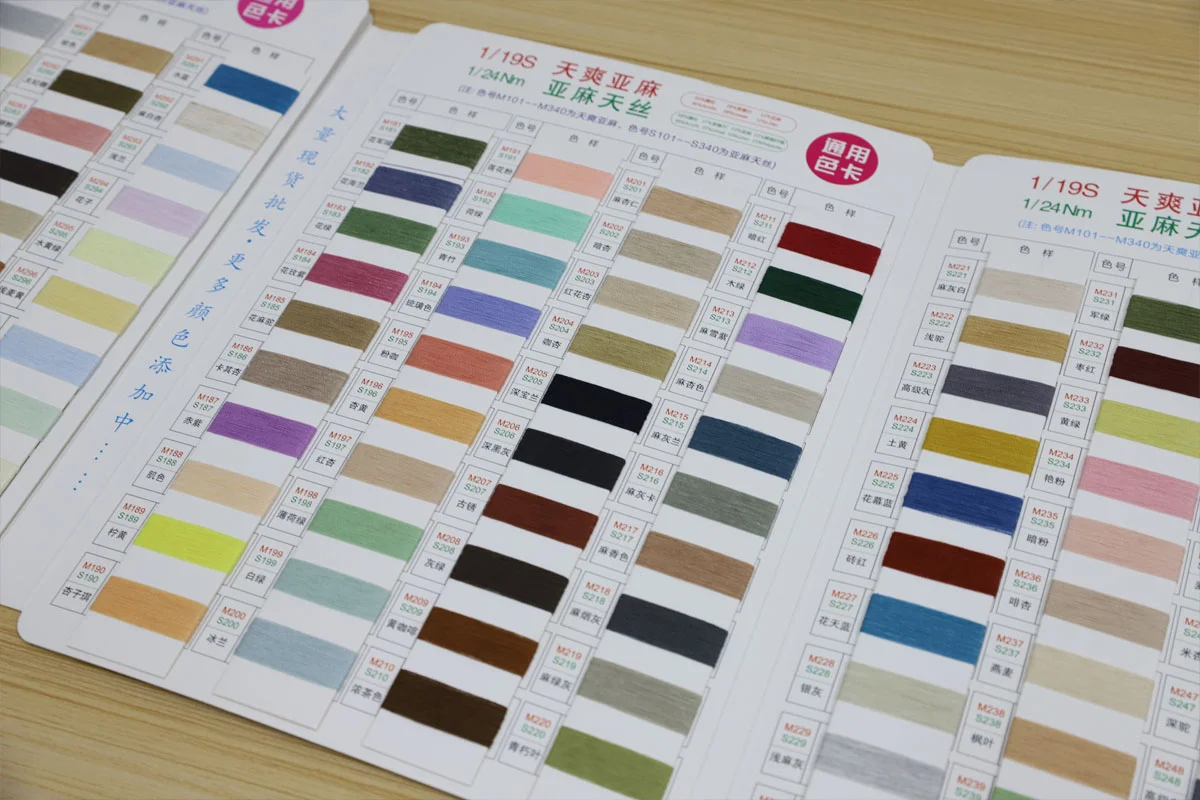
For both, always request a physical yarn swatch before confirming the specification — particularly for colour. Screen colours and knitted fabric colours are not the same. A colour that looks right on the spec sheet may require adjustment once knitted. This is especially true for mid-tones and pastels where small dye variations are visually amplified in knitted fabric.
The gauge you choose also interacts with the yarn. Fine gauge (10G–14G) in acrylic pills more visibly than the same gauge in merino. If you are planning a fine-gauge style, the case for wool or at least a wool-dominant blend is stronger than it would be at medium gauge.
The price reality — what the upgrade actually costs
To make this concrete: here is what the yarn upgrade costs in ex-factory price terms, using a standard women's crew neck at 300 pcs as the reference:
| Yarn specification | Ex-factory price (300 pcs) | Retail multiplier at 2.8× |
|---|---|---|
| 100% Acrylic, 7G | $9 – $13 | £20 – £30 retail |
| 30% Wool / 70% Acrylic, 7G | $13 – $18 | £30 – £42 retail |
| 50% Wool / 50% Acrylic, 7G | $16 – $22 | £37 – £51 retail |
| 100% Wool, 7G | $20 – $30 | £46 – £70 retail |
| 100% Merino, 12G fine gauge | $28 – $40 | £65 – £93 retail |
These are ex-factory prices at Dalang. Add freight, duty, and your retail margin on top. The full cost breakdown methodology is explained in our manufacturing cost guide.
The table makes the commercial logic clear. Upgrading from acrylic to a 30/70 wool blend adds roughly $4–5 per piece at factory level — which translates to a retail price uplift of £8–12 if you maintain your margin percentage. For a brand selling at £35–50, that upgrade earns its cost commercially. For a brand selling at £22–28, it does not.
QC — what to check that is different for each fibre
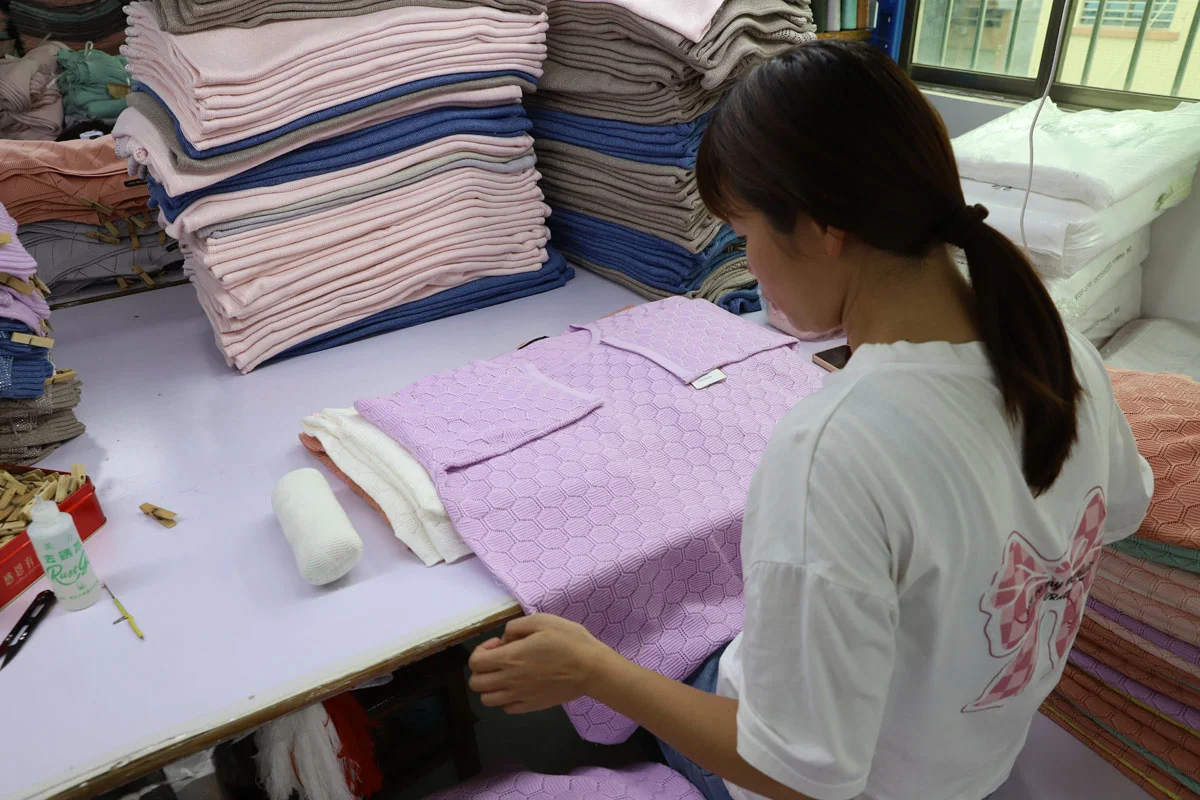
QC requirements are not the same for acrylic and wool. Buyers who apply the same inspection standard to both miss the fibre-specific failure modes:
- For acrylic: The main quality risk is pilling, especially at stress points — underarms, collar edge, cuffs. Check the yarn grade before ordering — higher-grade acrylic (anti-pilling acrylic) pills significantly less than standard and is worth specifying if your garment will see regular wear. Also check for electrostatic buildup in dry climates, which affects some acrylic formulations.
- For wool: The main quality risks are felting (from incorrect washing), dye lot variation (visible when pieces from different lots are placed together), and hand variation between different production batches if yarn suppliers change. Always request a dye-lot record with your production paperwork.
- For both: Dimension measurement against the approved sample. Both fibres can drift in gauge during a long production run if machines are not monitored — the drift is in different directions for each fibre, but the consequence (garments that do not match the approved sample) is the same.
Not sure which yarn is right for your collection?
Send us your target retail price and market positioning. We will recommend the yarn specification that makes commercial sense — before you brief the design.