There is no single "best" sweater manufacturer for Amazon FBA sellers — only the best factory for your current Amazon seller stage. A first-time seller testing a new ASIN at 300 pieces needs a completely different factory than a proven brand reordering 5,000 pieces to defend its #1 ranking. This article maps 7 distinct factory types to the 7 Amazon seller archetypes we've served, so you can identify which type to engage — and which to avoid — based on where your brand is right now. Includes a red-flag section on the drop-shipper factory type that new sellers get trapped by.
Why "best Amazon factory" depends on your stage
Amazon FBA sellers fall into 7 distinct operational profiles, each with a different capital constraint, risk tolerance, and inventory strategy. A 2,000-worker factory that serves a proven brand reordering 5,000 pieces is the wrong match for a pre-launch seller testing one ASIN at 300 pieces. The opposite is equally true: a 50-worker boutique workshop that's perfect for a startup test cannot handle a 5,000-piece bulk reorder.
Matching your stage to the right factory type is a larger ROI decision than negotiating unit price. The wrong type will either deprioritise your small order (if the factory is too large) or miss your growth window (if too small). Our Amazon private label service page covers our own positioning; this article covers the broader market.
The 7 factory types matched to Amazon seller archetypes
Each type below is matched to a specific Amazon seller archetype. Find yours in the "Best match" line to identify which factory type you should be engaging with:
Mid-size OEM (100–250 workers) specifically tooled for Amazon workflows: 300 pcs MOQ per style, US sizing as default, OEKO-TEX yarn, FBA-ready polybag + FNSKU label prep. Published category teardowns demonstrate Amazon-specific knowledge.
Typical clients: First-time FBA sellers launching with 300 pcs. DTC brands adding Amazon as second channel. Seasonal launches where inventory risk is concentrated.
Trade-off: Unit price 10–15% higher than 500-MOQ factories. But the saved inventory risk (300 pcs vs 500 pcs) usually more than offsets this.
Mid-to-large OEM factories (300–600 workers) specialising in repeat bulk orders. Same quality as Type 1 at slightly lower unit price when you're past the testing phase. Audited (BSCI, OEKO-TEX, sometimes WRAP).
Typical clients: Established FBA brands with 10+ ASINs, each with proven conversion. Brands targeting #1 BSR rank in subcategory defending market share.
Trade-off: Not the right fit for a first-time test. The 300-piece minimum becomes dead stock if your ASIN doesn't convert — a $4,500+ cash write-off is a brand-killing event for pre-seed sellers.
Boutique factory (40–80 workers) focused on one premium material (typically cashmere or extrafine merino). Direct yarn sourcing from Inner Mongolia or Australia. Luxury brand clients using Amazon as a secondary channel beside Shopify/DTC.
Typical clients: Brands targeting Amazon's luxury knitwear category ($80+ retail). Cashmere gifting DTC brands. Premium merino athleisure hybrids.
Trade-off: Specialists only in one material. If your brand wants mixed-material collection (cashmere + cotton in same range), you'll need 2+ factories. See our cashmere service for this category.
Not a factory at all. A Chinese seller account with a Shenzhen warehouse that ships unbranded generic sweaters from a subcontracted production partner under the seller's own Amazon brand (often a shell trademark like 4-letter random names). Targets first-time Amazon buyers via cheap PPC.
Red flags: (1) 100% acrylic specifications only — never OEKO-TEX cotton or merino; (2) "Not Amazon size. Size runs small." label in product description; (3) Generic 3D brand name (e.g., 4-letter pronounceable trademark); (4) Ships from China, long Prime-ineligible delivery window; (5) 30-day return rate elevated on Amazon. Our cable knit turtleneck teardown dissects exactly this type of listing.
Why sellers fall into this: Confuses "private label" with "buy cheap generic + rebrand". Real private label requires tech pack, sampling, and QC control — drop-ship skips all three.
Factories that ramp heavily April–September for Q4 Christmas production. Jacquard and intarsia specialists. Year-round baseline operation, peak mode during summer. Some offer family-matching coordination (women+men+kids+baby in same pattern).
Typical clients: Amazon Q4 brands launching November with 3–5 Christmas designs. Family-matching PJ/sweater brands. See our Christmas service and Christmas Amazon teardown.
Timing critical: April–May pricing lowest. Sourcing in August = double pricing and missed Q4 window.
Mid-size factories with dedicated grading teams across all demographic size categories. Can produce the same pattern in women's S-XXL, men's S-XXL, kids' 2T-14Y, and baby 3M-24M in parallel, from one sampling round. Family-matching Q4 category is fastest-growing Amazon knitwear segment in 2026.
Typical clients: DTC family lifestyle brands adding Amazon. Christmas-PJ-sweater family sets. See our kids knitwear service for this category.
Trade-off: Pattern has to work visually at all 4 body scales (baby proportions differ drastically from men's). Some jacquard patterns don't scale down cleanly to baby sizes.
Very large factories (500–2,000 workers) serving major retail accounts (Amazon Private Brands, Walmart+, Target, Kohl's). Minimum order is 1,000 pieces per style; most programs are 5,000–20,000. Full BSCI + WRAP + SA8000 audited. Dedicated compliance teams.
Typical clients: Amazon Private Brand program suppliers. Major retail wholesale importers. Brands with 20+ SKUs and $50M+ annual revenue.
Trade-off: Completely wrong for small or mid-size Amazon sellers. Account management multi-layered. 90-day lead time incompatible with agile Amazon testing.
5 Amazon-specific checks before engaging any factory
Generic factory-vetting questions miss the Amazon-specific operational details. Ask these 5 questions in the first email exchange:
Amazon-specific vetting questions
- "Do you grade to Amazon US sizing or Chinese domestic sizing by default?" Correct answer: Amazon US. If they say "depends on customer", they haven't internalised the default — be alert.
- "Is your yarn inventory OEKO-TEX STANDARD 100 certified?" Critical for Amazon's Climate Pledge Friendly filter. "Yes, we have certificates on request" is good; "we can source OEKO-TEX yarn on request" means they don't stock it — adds 10–14 days to your sampling timeline.
- "Can you apply FNSKU labels and prepare FBA-ready cartons?" Real Amazon-ready factory says yes without extra fee. Saves $0.50–$1.50 per unit in 3PL prep costs.
- "What's your typical MOQ for a first-test order?" Mid-size OEM: 300. If they say "500 minimum, no exceptions", they are not set up for Amazon testing regardless of what their website claims.
- "Have you produced any of Amazon's top 100 bestseller knitwear listings?" Honest factories either confirm specific category experience or admit they haven't. Deflecting answers indicate inexperience.
Where Lin Sweater fits — Type 1 and Type 6
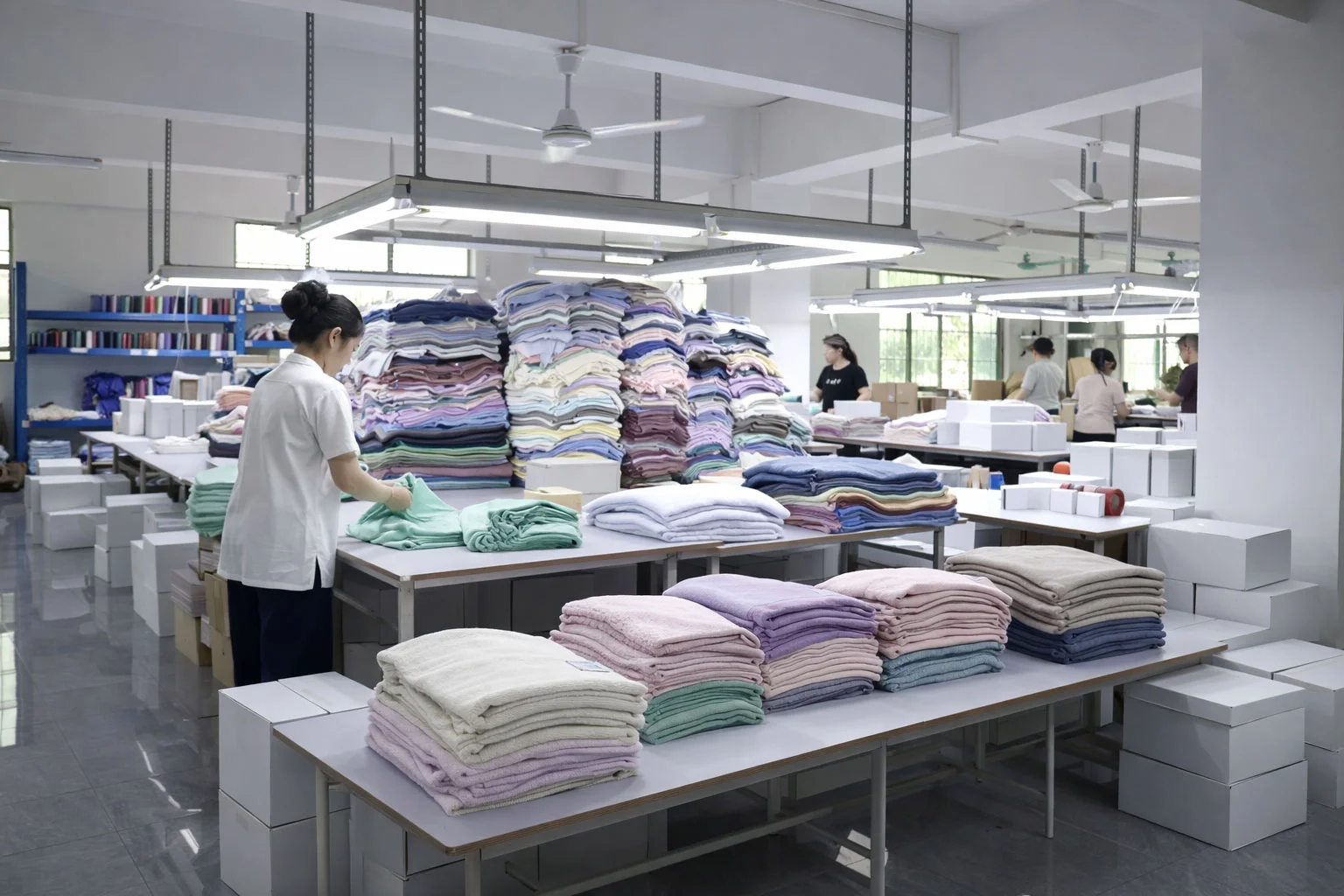
We are an honest match for Type 1 (Fast-Launch FBA OEM Factory) for Amazon sellers in their first 12–18 months of trading, and Type 6 (Multi-Demographic Coordinator) for family-matching brands. Our MOQ is 300 per style per colour per size category. We grade to Amazon US by default. OEKO-TEX yarn on all cotton, wool, and cashmere orders. FBA-ready polybag and FNSKU label application standard.
Where we are not the right fit:
- Type 3 Premium Material: We produce cashmere but are not a Type 3 specialist workshop with direct-mill integration. For $150+ retail cashmere lines, consider boutique specialists.
- Type 7 Enterprise: For 5,000+ piece programs, a Type 7 factory beats our pricing. Our unit economics are built for 300–2,000 pc range.
For Types 2, 4, and 5 — we either overlap (Type 2 scaling, Type 5 Christmas seasonal) or explicitly don't play (Type 4 drop-ship). Our 4 published Amazon category teardowns demonstrate Type 1/6 expertise on specific bestseller categories:
Identify your Amazon seller archetype — then match the factory
Tell us your Amazon stage (testing ASIN / scaling winner / premium launch / seasonal push / family-matching), target category, and quantity. We'll honestly tell you which factory type you need — Lin Sweater if we fit, or a different type if we don't. 24-hour reply.