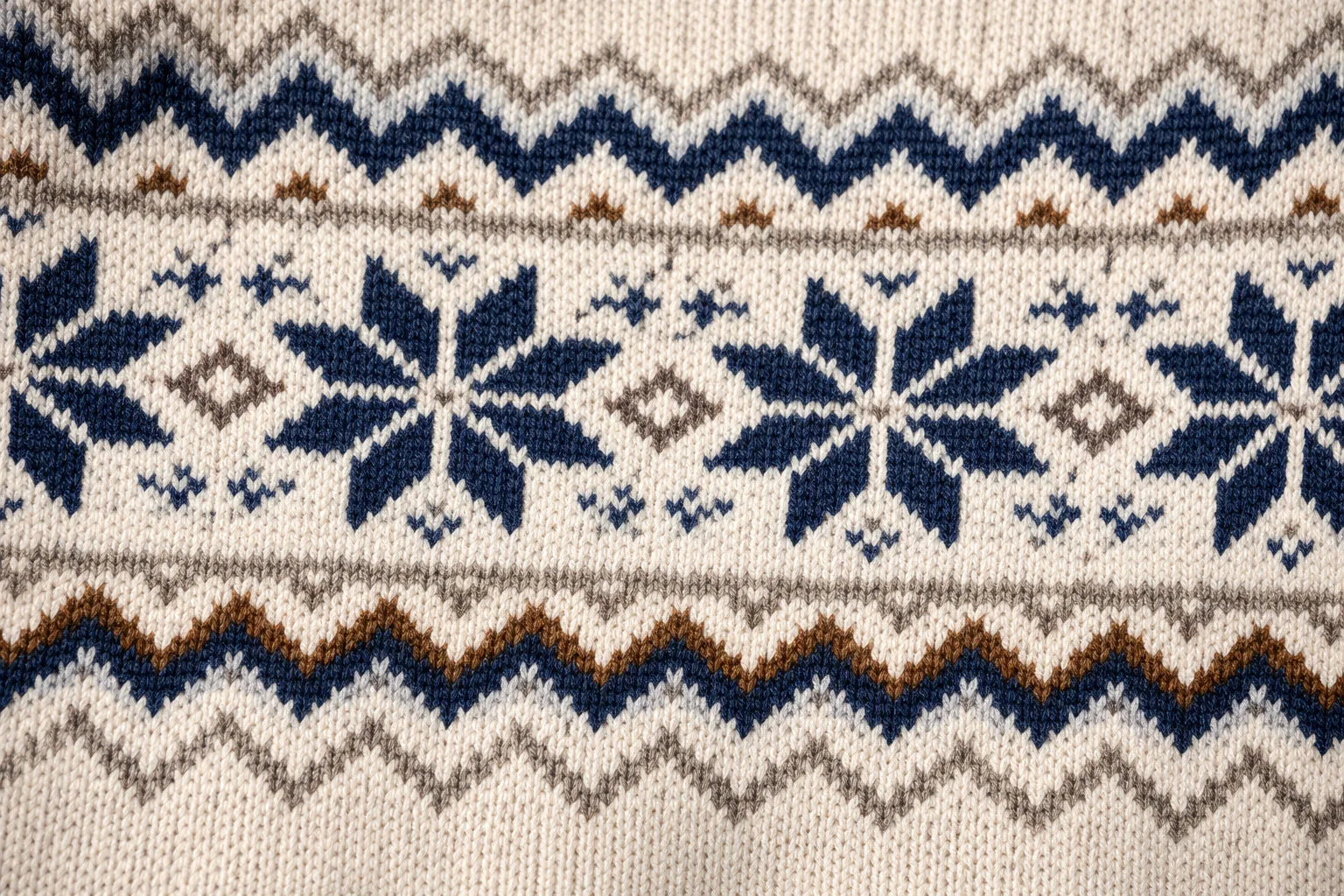
When a buyer asks us to add a pattern to a sweater, we always ask one question first: is the pattern knitted in, or added after? The answer determines everything — cost, sampling time, minimum quantity, and how the finished garment wears over time.
Jacquard, intarsia, and embroidery are the three most common ways to add pattern or branding to knitwear. Each one is produced using a completely different process, appeals to a different type of buyer, and is suited to a different kind of brief. Choosing the wrong one at the design stage costs you sampling time and money that is very difficult to recover.
This guide explains how each technique works from the factory floor, what it actually costs, where it excels, and where it falls short — so you can make the right decision before your brief reaches us.
Technique 01 — Jacquard
Jacquard Knitwear
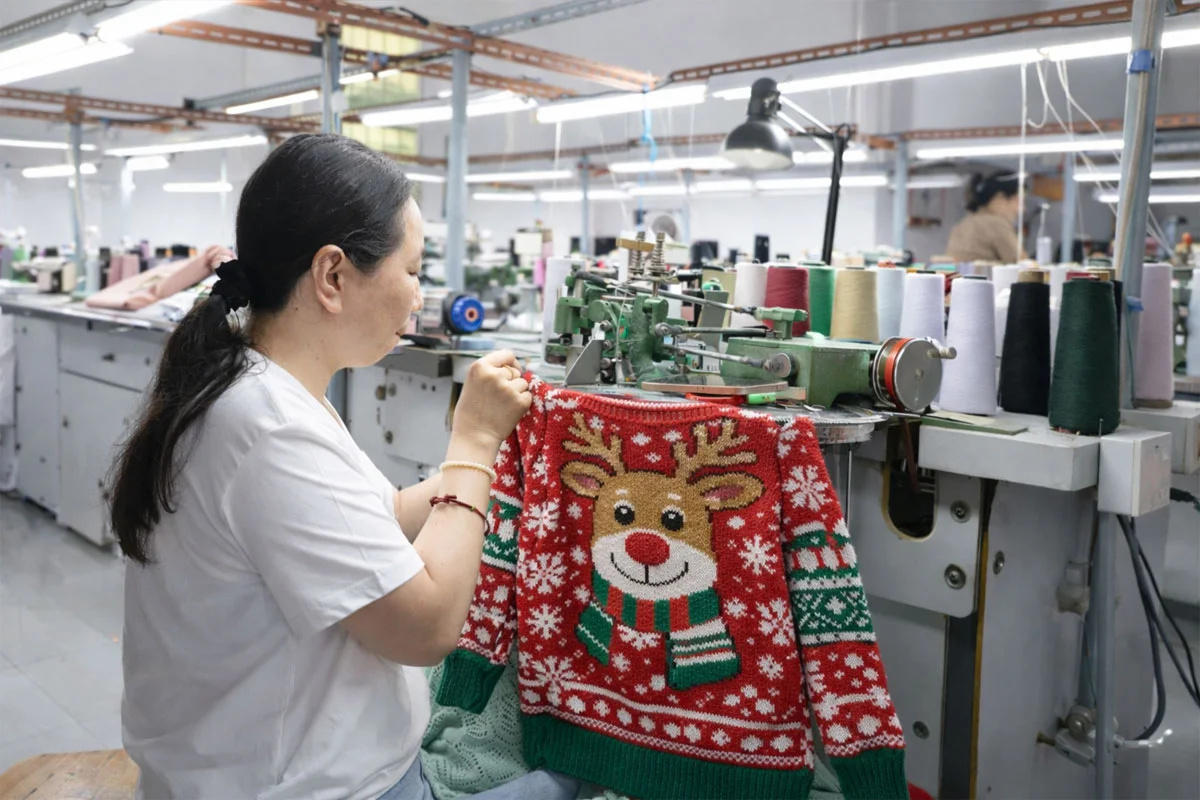
In jacquard knitting, the pattern is programmed into the knitting machine and produced at the same time as the fabric itself. Multiple yarn carriers feed different coloured yarns, and the machine selects which colour appears on the face of the fabric at each needle position according to the programmed pattern.
The yarns that are not active on the face of the fabric float across the back of the garment — these are called "floats." On a standard jacquard, floats run across the reverse side. On a double-knit jacquard, both sides are finished cleanly.
How jacquard is made — what happens at the factory
Before a single piece is knitted, the pattern is digitised and programmed into the machine controller. This is the most significant fixed cost in a jacquard order — programming time is the same whether the run is 300 pieces or 500 pieces. Once programmed, the machine knits the pattern automatically, row by row, panel by panel.
The pattern repeat is defined at the programming stage. A Fair Isle repeating motif requires less programming time than a large placement print that fills the entire front body. Colour changes — switching between yarn carriers — also affect machine speed: more colours generally means slower production.
What jacquard is genuinely good for
All-over repeating patterns — Fair Isle, geometric, Nordic, stripe-based, brand monogram repeats — are jacquard's natural territory. The technique shines when the pattern covers most or all of the garment surface. Seasonal patterns like Christmas sweaters — reindeer, snowflakes, argyle — are almost exclusively made in jacquard.
- All-over repeating patterns
- Fair Isle and Nordic styles
- Christmas and seasonal knitwear
- Brand monogram repeats
- Geometric and stripe patterns
- High-volume branded ranges
- Large single placement motifs
- More than 6 colours in one piece
- Very fine detail (photo-realistic)
- Patterns requiring thick colour blocks
See our full jacquard knitwear production page for capability details and samples.
Technique 02 — Intarsia
Intarsia Knitwear
Intarsia is fundamentally different from jacquard in one key respect: each colour area in an intarsia piece uses its own separate yarn carrier, and yarn is only used in the area where that colour appears. There are no floats across the back of the fabric. The reverse side of an intarsia piece is clean — each colour block is contained within its own area.
This makes intarsia the right technique for large, single placement designs — a bold animal motif on the chest, a large logo panel, a graphic that covers a significant portion of the garment. Jacquard would require the non-pattern yarn to float across the back of a large area, which causes puckering and distortion. Intarsia avoids this entirely.
Why intarsia costs more than jacquard
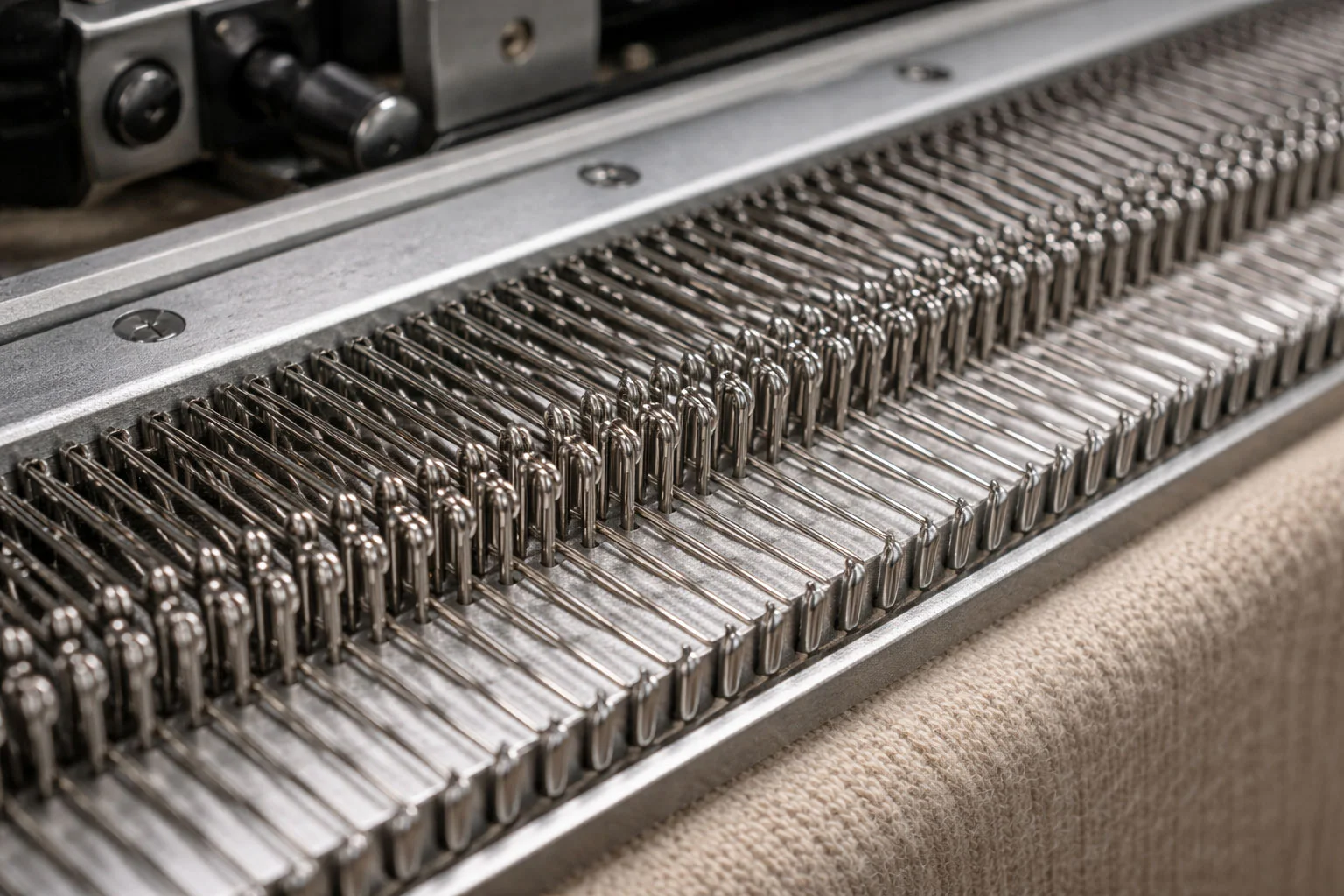
Intarsia is more labour-intensive than jacquard. Each colour section requires a separate yarn carrier that must be managed independently — set up, tensioned, and linked back in at each row. On a complex multi-colour intarsia with large irregular colour blocks, this process is partially manual. Machine speed is lower, and the skill requirement for the operator is higher.
The programming is also more complex — the machine controller must manage multiple independent yarn feeds simultaneously rather than switching between a fixed set of carriers. For a new intarsia design, add 3–5 extra days to your sample timeline compared to an equivalent jacquard.
The intarsia advantage: clean reverse, no bulk
Because there are no yarn floats, intarsia garments are lighter and more comfortable than a jacquard would be at the same scale. A large chest motif in jacquard would have a thick layer of floats on the inside — uncomfortable against the skin and adding unwanted weight. In intarsia, the inside is as clean as a plain knit.
This makes intarsia the right choice for premium placement designs where garment weight and interior finish matter — high-end brand knitwear, luxury gift products, and design-led fashion pieces.
- Large single placement motifs
- Bold colour block designs
- Large brand logo panels
- Premium fashion knitwear
- Animals, graphics, abstract shapes
- Luxury gifting products
- Small repeating patterns
- Very fine detail lines
- All-over pattern coverage
- Budget or high-volume basic orders
See our intarsia knitwear production page for design guidelines and examples.
Technique 03 — Embroidery
Embroidery on Knitwear
Embroidery is fundamentally different from jacquard and intarsia: it has nothing to do with the knitting process. The garment is knitted plain, and the pattern or logo is stitched onto the finished fabric surface using an embroidery machine. The design exists on top of the fabric, not within it.
This separation from the knitting process is both embroidery's greatest strength and its main limitation. Because the pattern is applied after knitting, it can be changed, repositioned, or updated without changing the base garment. A plain crew neck can be turned into a branded crew neck with a different logo simply by changing the embroidery file — the knitting remains identical.
What embroidery does well — and why brands use it
Embroidery excels at small, precise, brand-identity applications: a logo on the chest, initials on the sleeve cuff, a small motif at the hem. These applications require a level of detail and colour precision that is difficult or impossible to achieve with jacquard at standard knitwear gauges.
For private label buyers — brands that want their logo on a plain knitwear base — embroidery is the most cost-effective solution. The logo setup (digitising the embroidery file) is a one-time cost, typically $30–80. Once set up, the per-piece addition is low — usually $0.80–4.00 depending on stitch count and complexity.
The limitation: embroidery sits on top
The main limitation of embroidery is that it is a surface application. On soft, stretchy knitwear, a dense embroidery can cause the underlying fabric to pucker or distort — particularly on fine gauge fabrics where the stitch structure is more open. This is manageable with proper backing (a stabiliser placed beneath the embroidery area during stitching), but it requires the factory to have experience with knitwear-specific embroidery — which is different from embroidery on woven fabric.
Embroidery also does not scale well to large coverage areas. A full front chest graphic in embroidery would be extremely expensive (very high stitch count) and heavy. For large pattern coverage, jacquard or intarsia is always the right choice.
- Brand logos and initials
- Small chest or sleeve placement
- Private label basic ranges
- Corporate uniform programmes
- Adding branding to plain knitwear
- Precise small-scale detail work
- Large coverage patterns
- Very fine gauge fabrics
- Pattern as primary design element
- All-over or repeating designs
Side-by-side comparison
With all three techniques explained, here is the full comparison across the dimensions that matter most to buyers:
| Jacquard | Intarsia | Embroidery | |
|---|---|---|---|
| How pattern is made | Knitted in — multi-colour yarn carriers | Knitted in — separate yarn per colour block | Stitched on — applied after knitting |
| Pattern coverage | All-over or repeating | Single placement, large motifs | Small to medium, any position |
| Reverse of fabric | Yarn floats visible | Clean — no floats | Backing visible at embroidery area |
| Number of colours | 2–6 per piece | 2–8 per piece | Virtually unlimited |
| Cost vs plain knit | +20–45% | +35–65% | +$0.80–4/pc (lowest) |
| Sample time | 7–12 days | 10–15 days | 5–8 days (fastest) |
| MOQ at Lin Sweater | 300 pcs | 300 pcs | 300 pcs |
| Design flexibility | High — limited by colours | High — limited by area scale | Highest — change any time |
| Durability | Permanent — lasts garment life | Permanent — lasts garment life | Very good — may loosen on stretch |
| Best gauge | 5G–12G most common | 5G–10G most common | 7G–14G (finer is harder) |
| Typical use case | Christmas sweaters, Fair Isle, branded print | Premium motif, designer graphic, large logo | Brand label, small logo, corporate uniform |
How to choose — a practical decision guide
Before you brief a factory, answer three questions. Your answers will point directly to the right technique:
1. How large is the pattern? — Small logo or motif → embroidery. Large single placement → intarsia. All-over repeating design → jacquard.
2. How many colours? — More than 6 distinct colours in a complex design → embroidery. Large clean colour blocks → intarsia. Multi-colour repeat → jacquard.
3. Might the design change between seasons? — If yes, embroidery gives you flexibility to change the logo or motif without re-tooling the knit. If the pattern is fixed for the long term, a knitted technique (jacquard or intarsia) gives better durability.
With those answers in mind, here is the shortcut:
- Pattern covers most of the garment
- Design repeats across the fabric
- 2–6 colours, no large plain blocks
- Seasonal or branded print range
- Volume is medium to high
- Large single motif on chest or back
- Bold, clean colour block design
- Interior finish matters (no floats)
- Premium or designer positioning
- Logo or graphic is centrepiece
- Small logo or brand mark only
- Adding branding to plain knitwear
- Design may change each season
- Corporate or uniform application
- Fastest turnaround needed
Can you combine techniques?
Yes — and some of the most effective branded knitwear pieces do exactly this. Common combinations:
- Jacquard body + embroidered logo. An all-over Fair Isle or geometric jacquard as the base design, with the brand's woven or embroidered logo added at the chest or back neck. The jacquard creates the seasonal aesthetic; the embroidery delivers the brand identity precisely.
- Intarsia motif + embroidered detail. A large intarsia graphic on the front body, with fine embroidered text or a small supplementary element added after. Intarsia cannot achieve the fine line detail that embroidery can — combining them uses each technique for what it does best.
- Plain knit + embroidery only. The simplest private label approach — a clean, well-made plain crew neck or cardigan with a precisely embroidered brand logo. This is how most luxury and premium basics brands approach knitwear branding. See our small MOQ guide for how this works from 300 pcs.
How to brief your factory on patterned knitwear
Once you have chosen your technique, the quality of your brief determines how smooth sampling will be. The most common sampling delays in patterned knitwear come from incomplete briefs — the factory makes assumptions that turn out to be wrong.
For jacquard, your brief should include: the colour palette with physical or Pantone references, a clear pattern repeat diagram or file, the gauge you want (or your target fabric weight), and any constraints on float length if you need the reverse to be presentable.
For intarsia, your brief should include: a scaled diagram showing exactly where each colour block sits on the finished garment, the number of distinct colour areas, and whether any areas have overlapping or irregular edges. The more precisely you define the colour boundaries, the more accurately the factory can programme the design.
For embroidery, your brief should include: the artwork file (vector preferred), the target stitch count or size in mm, the exact placement position on the garment (measured from a reference point), and whether you need the backing visible or hidden. For knitwear specifically, always specify that the factory must use appropriate knitwear stabiliser — this is the most common technical error with embroidery on stretch fabrics.
For all three techniques, always include a physical or digital reference for the base garment alongside the pattern brief. The garment and the pattern are a system — pattern decisions that work on one silhouette may not work on another. See our guide on why sampling delays happen for a full checklist of what to include in a brief.
Cost in context
Pattern adds cost — but not always as much as buyers expect. To give a realistic frame:
- A plain women's crew neck at 7G in wool-acrylic might cost $12–18 ex-factory at 300 pcs.
- The same style in a 4-colour Fair Isle jacquard: $16–24 — roughly 30–35% more.
- An equivalent intarsia with a large chest motif: $20–28 — roughly 50–60% more.
- The plain crew neck with a small embroidered logo: $13–20 — the logo adds $1–2 per piece.
The cost difference between jacquard and a plain version is often smaller than buyers assume. For the right product — a seasonal collection, a branded range, a distinctive design — the premium is commercially justified. The key is choosing the right technique for the right product, so the added cost serves the design rather than working against it.
For a full breakdown of what drives knitwear costs at every stage, read our manufacturing cost guide.
Not sure which technique fits your design?
Send us your reference and we will assess which technique is right, flag any production considerations, and give you a quote — before you commit to sampling.